


Owela Pedagogy and Publications
OWELA publications look at special topics theatre and performance studies, art histories, care work, decent work, social protection for artists, live art and the archive.


The Issue with Care ZINE
Edited by Nashilongweshipwe Mushaandja, Nadine Siegert and Katharina Fink. Co-Published with Iwalewa Books. With contributions by Beauty Boois, Namupa Shivute, Suzie Ndandika Shefeni, Asnath Paula Kambunga, Lutivini Majanja, Bediz Yılmaz, Esmeralda Cloete, Florence !Kho /Noahe /Khaxas, Yvette Abrahams, The Nest Yoga Place Joburg and moshood.
This volume comes from an impulse of needing to think, imagine and feel care whilst living through several global pandemics: COVID-19, racism, femicide, queercide, climate crisis. The years are 2020 and 2021 and suddenly the need for radical care is heightened. These years reminded us about the relational ethics needed for cultivating and engaging with care. Caring for others is caring for the self. Care is a verb, meaning that it is a sensorial and shared practice in principle. While care and caring seem to be essential aspects of humanity, Maria Puig de la Bellacasa’s theorisation of care reminds us that care is ambivalent, complex and speculative because it means different things to different people.
Speculative Cartographies: Scattered Maps by Three Namibian Artists in the Diaspora
There are far too few studies on Namibian art and artists in the diaspora. In response to this, I look at the work of Herman Mbamba, Jackson Wahengo and Shishani Vranckx. Mbamba is a visual artist based in Haugesund, Norway while musicians Wahengo and Vranckx are based in Copenhagen, Denmark and Amsterdam, The Netherlands, respectively. I offer an aesthetic reading, unpacking their work as counter-hegemonic maps, that signal the places of imagining otherwise. Wahengo and Vranckx’s songs lean towards national cultural memory while Mbamba’s abstract and figurative paintings conceal everyday realities. The concept of speculative cartography is applied, to read how these artists as African Diasporic subjects, speak to historic displacements and scatterings, while orientating themselves within national cultural memory that goes beyond ‘Namibianess’ or the African Diaspora. I argue that the speculative cartographies generate Thirdspaces that collapse binaries between settled and unsettled, imaginable and unimaginable, material and metaphysical spaces.
Owela Theatre and Performance Seminar 2021
This seminar was initiated as an urgent response to the lack of extensive research on Namibian theatre and performance. There are many gaps in knowledge of the theatre and performance sector that require critical and reflexive engagements. Every year, a wide range of performances are hosted at the National Theatre of Namibia and many other public spaces around the country, and yet these productions fall through the cracks of the archives of Namibianist public culture. They remain unstudied, under-valued and hence are likely to be forgotten in what is already a marginalized sector.
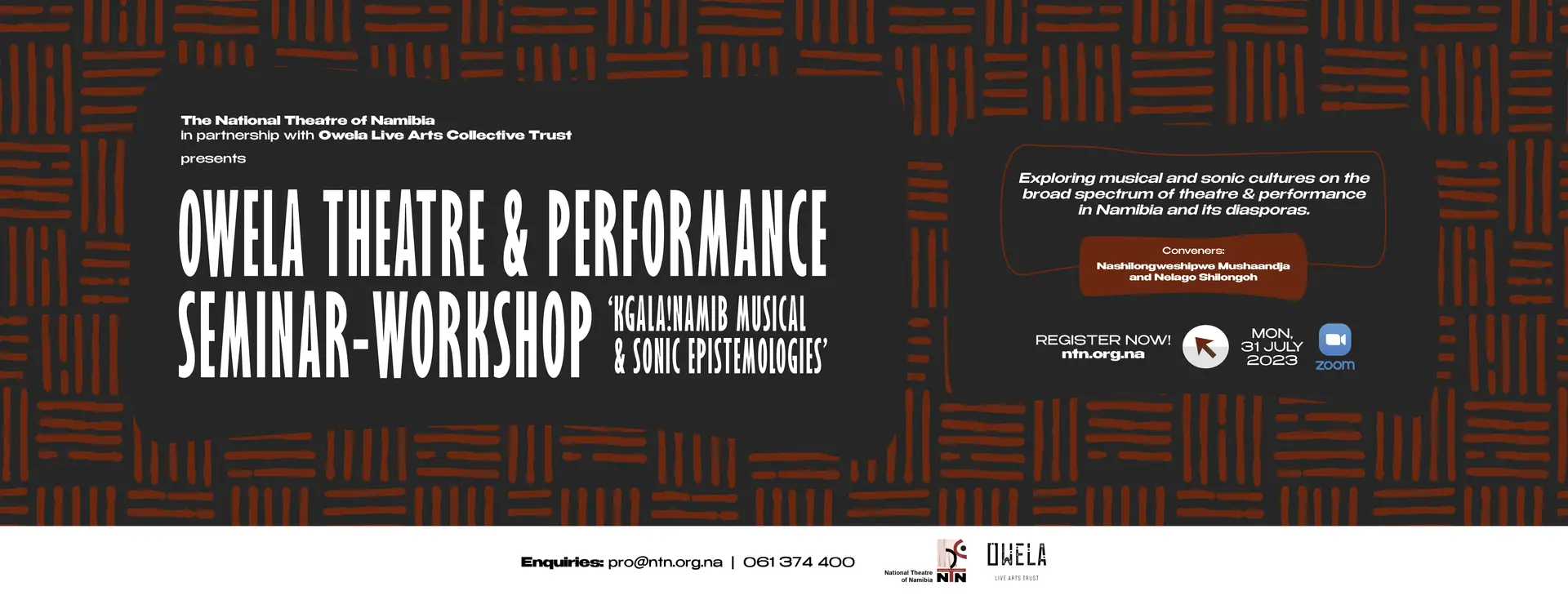
Owela Theatre and Performance Seminar 2023
As a follow up of the first ‘Owela Theatre & Performance Workshop: Genealogies, Orientations and Raptures’ in October 2021, we envisioned 2023 Owela seminar on the theme ‘Kgala!Namib Sonic and Musical Epistemologies’. We were thinking about musical and sonic cultures on the broad spectrum of theater and performance in Namibia and its diasporas. We adopted Elemotho’s spatial concept of Kgala!Namib, which is a title of his 2003 song that features Jackson Jnr Kaujeua. The title is a combination of the names of Namibia’s two deserts, the !Namib and Kalahari. Kgala!Namib is about the arid yet diverse Namibian landscape, appreciating its natural beauty of ‘wide and open spaces’. This song is not limited to the physical landscape of Namibia, it acknowledges people from near and far, calling them to think and feel ‘the spirit of the Namibian nation’. Kgala!Namib is one of countless songs produced as part of Namibia’s post-apartheid elation in the making of the ‘Namibian sound’.
We are interested in critically imagining this notion of the Namibian sound as one that interfaces indigeneity with colonial modernity. We have the following questions in mind. What is at stake in the historical and contemporary cultural production of the ‘Namibian sound’? Considering the mobility of sound and music, how useful (or not) is the notion of the ‘Namibian sound’? How have indigenous music and sonic practices been locally understood as methods of knowledge production? What role do they play in unsettling hegemonic cultural production? How are contemporary music makers, sound artists, theatre makers, performance artists, curators and historians drawing on Namibia’s rich sonic archives and musical heritages to make sense of their pasts and futures?